Reflections from Hello Tomorrow: The DeepTech Communication Challenge Is About Worlds Speaking Different Languages
As deep tech companies move closer to commercialisation, communication becomes an exercise in translation. Not only between science and market, but between investors, buyers, R&D teams, procurement leaders and operators who all evaluate progress differently. Our reflections from Hello Tomorrow explore why this translation challenge is becoming central to how industrial innovation companies build credibility, visibility and traction beyond the laboratory.
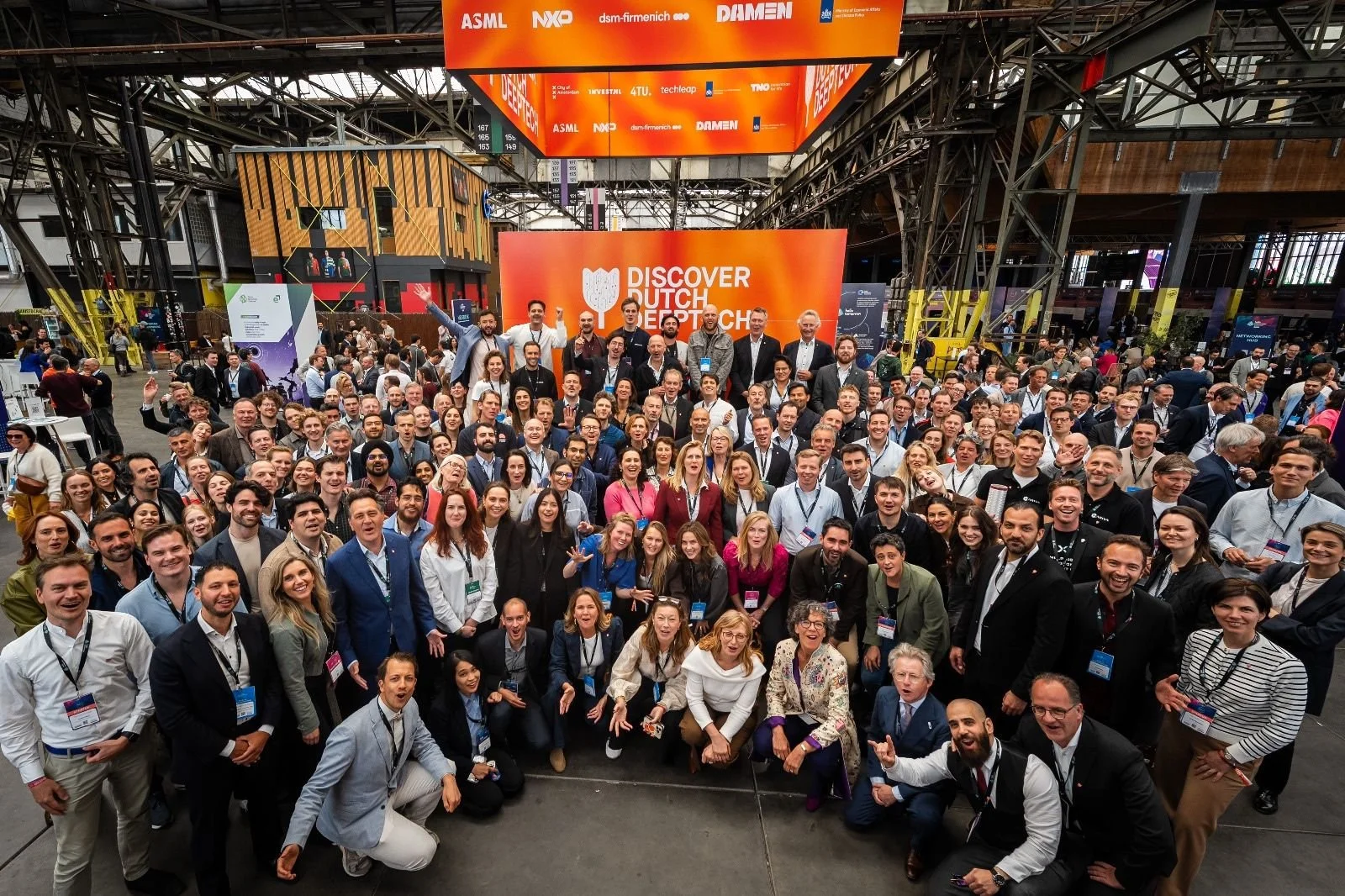
We spent last Thursday and Friday at one of the unmissable events of the year for the DeepTech ecosystem: Hello Tomorrow, hosted this year practically in our own backyard, in Amsterdam.
After dozens of conversations with founders, investors, corporates, and ecosystem stakeholders, I found myself returning to the same observation time and again.
As industrial deep tech moves beyond the laboratory, into VC offices and closer to commercialisation, communication increasingly becomes an exercise in translation, and not always a successful one.
Whether we are talking about red or green biotech, space, photonics, advanced materials, or medical devices, founders and investors seem to agree on one thing: effective positioning, once a company has moved beyond the earliest stages of technical validation, often depends on understanding, learning, and speaking the language of the counterpart.
Not English or French, but the language of investors, plant managers, R&D directors, procurement teams, and P&L owners.
The complexity begins with the nature of deep tech itself. Many companies start life as extraordinary scientific breakthroughs in search of the right application and the right industry problem to solve. They are often platform technologies with the potential to address multiple industries, value chains, and market opportunities.
The possibilities are vast - which entails significant potential for narratives that become overly technical, convoluted, difficult to follow, and ultimately clear only to the founders behind them.
As these companies move beyond technical validation and begin engaging with customers, partners, and application markets, the conversation inevitably needs to evolve.
The question is no longer simply whether a technology works. It becomes where it creates the most value, for whom, why now.
This is where many founders find themselves navigating a delicate balancing act. On one side sits the long-term potential of the technology. On the other hand, the need to communicate clearly and credibly with stakeholders who are focused on solving immediate business challenges.
Across many of the conversations we had this week, it became apparent that one of the greatest communication challenges facing industrial deep tech is maintaining that balance. Founders need to convey ambition without overstating certainty. They need to communicate future potential while remaining grounded in present-day realities.
Buyers operate within a complex reality shaped by performance requirements, operational constraints, implementation risks, procurement processes, and commercial targets. Investors, meanwhile, may have impact mandates and are often looking for the potential step-change, the “X multiplier” opportunity. This creates a constant tension for founders, who must articulate a transformative vision while simultaneously building confidence that they have a clear and credible path towards the milestones that sit between technology transfer and commercial contracts.

Another theme that surfaced repeatedly was visibility.
Industrial deep tech operates on exceptionally long timelines. Partnership discussions, pilot programmes, validation phases, regulatory approvals, and procurement decisions often unfold over years rather than months.
Visibility, therefore, becomes essential not only for attracting customers but also for engaging investors, demonstrating progress, and building trust over time.
Once a company begins actively engaging with application markets, visibility serves a broader purpose. For investors, consistent communication helps demonstrate momentum between major milestones. For potential partners and customers, it provides reassurance that a company is actively participating in the industry, learning from the market, and steadily building credibility.
Perhaps the most interesting takeaway from the past week is how remarkably consistent these challenges appear across sectors.
Whether the conversation centred on industrial biotechnology, advanced manufacturing, photonics, novel materials, or energy systems, many founders seemed to be grappling with the same questions.
- How do we explain complexity without oversimplifying it?
- How do we communicate possibility without creating unrealistic expectations?
- How do we engage investors, corporate partners, and future customers when each audience evaluates progress through a different lens?
These may sound like communication questions, but in reality, they are commercial and funding questions.
And they become increasingly important as more industrial deep tech companies move beyond the laboratory and begin navigating the realities of market adoption.
A small spoiler alert: over the coming months, at EDERA Lab, we want to explore these themes further.
This summer, we will be speaking with founders, investors, corporate innovation teams, and ecosystem stakeholders across Europe to better understand how communication, narrative development, and visibility influence the commercial trajectory of industrial deep tech companies.
We have a few hypotheses.
Now it is time to test them.
More soon.
EDERA Lab is a marketing and communications partner for deep tech and industrial innovation companies, helping founders translate complex technologies into clear narratives for investors, buyers and commercial partners. Explore our deep tech and industrial innovation marketing services, or get in touch to discuss your positioning, PR and visibility needs.